Medical Tech Outlook Weekly Brief
Be first to read the latest tech news, Industry Leader's Insights, and CIO interviews of medium and large enterprises exclusively from Medical Tech Outlook
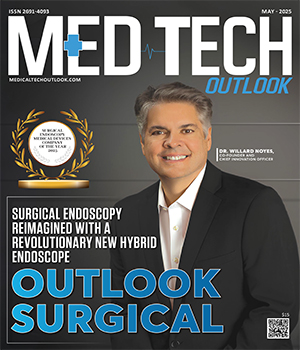
For decades, surgical endoscopy has relied on either rigid or flexible endoscopes—each with its own advantages and limitations. Traditional endoscopic tools present a dilemma: rigid endoscopes provide precision but lack flexibility, while flexible endoscopes offer maneuverability but require complex two-handed operation. These limitations often hinder surgeons’ ability to perform procedures efficiently. Frustrations with these constraints have driven innovation, leading to the development of hybrid endoscope systems that combine the strengths of both designs. These systems improve surgical efficiency and enhance patient outcomes. Advancing Surgical Innovation with Outlook Surgical A notable breakthrough in this field is Outlook Surgical’s Inova 1 hybrid endoscope system, which represents both an evolution and a revolution for physicians. Engineered specifically for head and neck procedures— including sinus surgeries, facial plastics, and related subspecialties—Inova 1 bridges the gap between traditional endoscopic tools and real-world surgical needs. Validated by surgeons, the system offers a simpler, more streamlined approach to endoscopic procedures, significantly reducing procedure times. The technology enables one-handed operation while providing a crystal-clear HD image on any HDMI monitor. It also allows users to navigate and work around corners— something that existing devices cannot achieve. “Our profession has been using the same flexible and rigid endoscope technology for over 30 years. It's time for a change,” says Dr. Willard Noyes, Co-Founder and Chief Innovation Officer of Outlook Surgical. Inspired by Dr. Noyes’s vision to advance endoscopic technology, the Inova 1 system is the result of his early contributions to surgical innovation—work that has earned him multiple U.S. and international patents. His efforts continue to push the boundaries of modern endoscopic procedures. “Our device offers simplicity, improved surgical access, better visibility, versatility, and efficiency for physicians—all of which translate to reduced risk and fewer complications,” says Dr. Noyes. “At the same time, it enhances patient comfort, improves outcomes, and lowers costs.” A Hybrid Design for Greater Efficiency The Inova 1 combines the benefits of both rigid and flexible designs, offering distinct advantages over traditional models. Unlike conventional flexible endoscopes, which require two hands—one to stabilize the shaft and another to articulate the tip—Outlook Surgical’s hybrid design eliminates the need for articulation. By attaching directly to the instrument, the Inova 1 allows surgeons to operate both the scope and instrument with one hand, freeing the other hand for additional tools and improving efficiency. In contrast, existing rigid scopes require continuous manual control, limiting the user to one instrument at a time. By integrating the Inova 1 endoscope with an instrument or rigid attachment sleeve, surgeons gain a more versatile and streamlined solution that optimizes workflow.
Shiftwave, a state-of-the-art neuroregulation device initially designed for Special Forces, was created with a commitment to “helping others and healing ourselves.” This mission is deeply personal for CoFounder/CEO Dr. Mike North. Motivated by the need to reset his life after tragedy, he turned to science to restore himself. The origins of Shiftwave trace back to one of the most challenging moments of Dr. North’s life. In 2015, he lost his best friend in the Mount Everest earthquake. While grieving, he suffered another blow—an injury at his friend’s memorial left him with a broken leg. Amid the pain and grief, he clung to his friend’s words: “There are no problems, only opportunities.” That mindset led him to explore vibration therapy for healing, ultimately designing a 3D-printed cast embedded with transducers and biometric sensors. Partnering with Alan Macy, co-founder of BIOPAC Systems, the project quickly gained momentum. Together, they developed an app connected to the cloud, allowing North’s doctor to remotely monitor his movement and swelling. The innovation drew widespread attention, earning a feature in Forbes Magazine titled ‘Medicine of the Future’. This groundbreaking work soon led to a Department of Defense (DOD) project, where they developed smart prosthetics for veterans. These prosthetics restored mobility and gathered insights into the wearer’s stress levels and emotional state—data that proved highly valuable. Taking their research even further, Macy and North built a highly advanced psychophysiology lab in Santa Barbara. Macy’s expertise was unparalleled—his company, founded in 1984, remains one of the world’s leading firms in psychophysiological measurement, with its technology used by nearly every major university. They measured physiological and psychological responses in the lab, developing tactile technology to communicate with the body and mind through touch. John Foster, PhD joined to help drive the science and technology forward, carrying over his experience from his previous company where he created the world’s first clinical cell sorter. After three years of deep research, the team identified specific vibration patterns and frequencies capable of dramatically shifting a person’s physical and mental state. Their research suggests these patterns may balance the nervous system, alleviate stress and anxiety, and induce 'synthetic sleep,' resembling deep sleep's physiological markers of increased CSF flow and slow wave brain activity


DPE Medical is built on one simple truth—the world is not flat. To regain independence, patients must be able to navigate all types of surfaces. This isn’t just a slogan; it’s actually what ignites the foundation of DPE Medical.
In the early 1990s, Daniel was diagnosed with Guillain-Barré syndrome. Completely paralyzed for months, he embarked on a long and grueling journey of rehabilitation. When he finally regained enough strength to walk with a walker, the medical team deemed him ready to return home. But at his doorstep, four simple stairs stood in his way. He could barely lift his foot two inches—let alone the six inches needed to climb them. The only solution available in the rehab clinic was a fixed six-inch wooden staircase. The problem and the available solution were one, and both out of his reach.
Think about learning to shoot a basketball. If you’ve never touched a ball before, you wouldn’t start by attempting a three-point shot over and over, hoping for success. Instead, you’d start by dribbling, building strength, practicing close-range shots, and gradually working your way back. Physical therapy follows the same logic. Recovery happens in small, progressive steps, and stair rehabilitation should not be any different.
Through his recovery, Daniel realized two critical things. First, existing rehabilitation equipment wasn’t designed to support patients through the full journey to independence. Second, the kindness of family, friends, and even strangers played a crucial role in his recovery. Inspired by this, he decided to dedicate his life to giving back—helping others overcome the same challenges he faced.
-3.jpg) That vision led to the development of the DST models, built on the core principle of gradual practice. Just as people must sit before they stand, stand before they walk, and walk before they run—stair negotiation must be practiced in progressive stages. The DST devices provide 10-foot parallel bars that transform by a click of a button into an adjustable staircase (ranging from 0 to 6.5 inches) and an incline (adjustable up to 24 degrees). So patient can practice all heights from zero up to their desired goal.
That vision led to the development of the DST models, built on the core principle of gradual practice. Just as people must sit before they stand, stand before they walk, and walk before they run—stair negotiation must be practiced in progressive stages. The DST devices provide 10-foot parallel bars that transform by a click of a button into an adjustable staircase (ranging from 0 to 6.5 inches) and an incline (adjustable up to 24 degrees). So patient can practice all heights from zero up to their desired goal.
Traditional syphilis testing follows the Centers for Disease Control and Prevention’s (CDC’s) two-step algorithm, combining non-treponemal and treponemal tests. Historically, screening began with a non-treponemal test, followed by confirmation with a treponemal test. However, these lab-based methods were time-consuming and sometimes less accurate. The delay in results was a major concern, as studies showed that many individuals never returned for their STI results, hampering timely treatment, increasing the risk of transmission, and worsening health outcomes. Pregnant women face even higher risks—without quick diagnosis and treatment, syphilis can pass to the fetus, leading to preterm birth, severe lifelong complications, or even stillbirth. Given these dangers, there is an urgent need for faster, more accessible testing to ensure immediate treatment and prevent transmission. Addressing this gap, Diagnostics Direct has been at the forefront of public health efforts to combat the syphilis epidemic with its flagship product, Syphilis Health Check™. The CLIA-waived diagnostic test is FDA 510(k)-cleared and offers distinct advantages over traditional lab-based methods by providing instantaneous results at the point of care. Unlike standard procedures that involve blood draws and lab processing times, this test enables healthcare practitioners to diagnose and treat patients in a single visit. Positive patients can receive treatment immediately, reducing the chances of losing patients to follow-up. The test is also more sensitive and can detect syphilis as early as 10 days after exposure—compared to 30 days or more with other tests. It plays a critical role in birthing hospitals screening for congenital syphilis, ensuring early intervention for both mothers and newborns. “Our mission is to empower healthcare professionals and organizations by delivering high-quality diagnostic solutions that meet their evolving needs. We strive to offer cutting-edge products that contribute to the improvement of healthcare outcomes globally,” says Jeff Tobias, co-founder and chief operating officer of Diagnostics Direct.

Colonoscopy Guidance System

Anne Mary K. Montero, Medical Director, Indiana University Health
Orthopedic Devices and Instruments

Michael Schmidt, Director of Ambulatory Rehabilitation, Duke University Health System
Surgical Devices and Instruments

Christopher Joseph, Director of Physical Therapy, Kennedy Krieger Institute
Surgical Devices and Instruments

Michelle Limberg, Director Surgical Services, CCL, IVR, Endoscopy, SSM Health
Surgical Devices and Instruments

Loren Wilson, Manager of Laboratory Quality and Point of Care Testing (POCT), Children’s Health

Surgical Devices and Instruments
Tyler Giess, Director of Laboratory, Washington Regional

Physiotherapy and Pain Management
Paul Rains, System SVP Behavioral Health, CommonSpirit Health
Rise of Intelligent Diagnostics, Surgery and Recovery Solutions
Post-surgery or disease treatment, patients often require rehabilitation solutions that integrate robotic exoskeletons and AI-enhanced wearables to restore mobility and function efficiently. For neurological challenges like chronic pain or movement disorders, nervous system regulation devices use bioelectronic medicine and smart neuromodulation to finetune nerve signaling and optimize recovery. This seamless flow—from rapid diagnosis to advanced treatment, precision surgery and intelligent rehabilitation—illustrates the growing synergy within MedTech.
Driven by these trends, syphilis testing is growing at a CAGR of 5.6 percent, rehab tech at 8.3 percent, neuro-regulation devices at 9.3 percent and endoscopy at nearly 4 percent.
The magazine features a thought leadership article by Paul Rains, System SVP of Behavioral Health at CommonSpirit Health, who talks about the evolving landscape of mental health delivery in the U.S. Another featured article by Tyler Giess, Director of Laboratory at Washington Regional, explores strategies for navigating regulatory change.
We also spotlight the stories of MedTech companies delivering solutions crucial to driving innovation. One of them is Outlook Surgical, which reimagines endoscopic procedures with a compact, one-handed hybrid system that combines rigid tools’ precision with modern design’s flexibility, bringing surgical efficiency, portability, and adaptability into sharper focus.
The magazine features the Rapid Syphilis Testing Company of the Year 2025, Top Rehabilitation Solution 2025, Nervous System Regulation Devices Company of the Year 2025 and Surgical Endoscopy Medical Devices Company of the Year 2025; we hope you find the right partner to meet your organization’s needs. Let us know your thoughts!