Medical Tech Outlook Weekly Brief
Be first to read the latest tech news, Industry Leader's Insights, and CIO interviews of medium and large enterprises exclusively from Medical Tech Outlook

Every year, thousands of ligament and tendon repairs are performed with the same objective: restore stability while supporting the natural biomechanics and biologic processes that guide healing. As soft tissue reinforcement has evolved over the past decade, surgeons have gained access to a growing range of augmentation technologies, each designed to improve repair outcomes. Over time, the industry has embraced three distinct engineering philosophies: 1. Technologies that prioritize strength, providing maximum reinforcement. 2. Technologies that prioritize flexibility, emphasizing load sharing. 3. Technologies that prioritize resorption, providing temporary support. Each of these approaches has advanced the field, yet each asks surgeons to balance trade-offs between mechanical performance, biological integration, and long-term function.
EstheticPro was founded on the belief that better microneedling outcomes begin with better education. After more than 25 years in aesthetics, education and clinical training, founder Millicent Russo recognized that as microneedling became more widely adopted, practitioners often depended on manufacturer-led education rather than an expert-led, science-focused approach. That insight shaped EstheticPro’s education-first initiatives before guiding the development of technology designed specifically for professional aestheticians, helping practitioners apply consistent, science-based protocols and make informed treatment decisions. “We’re by aestheticians, for aestheticians. Every customer touchpoint is designed with the practitioner in mind, and our focus is always on improving their experience,” says Russo.


JK Kim, President and CEO
Modern surgical visualization systems have significantly improved clinical precision. Yet the technologies designed to improve what clinicians see can also introduce ergonomic challenges. Heavy equipment, cable clutter and workflow friction during procedures often contribute to physical strain, leading to a tradeoff between clinician comfort and surgical performance. BiLumix designs surgical visualization systems that eliminate the tradeoff between comfort and performance. It integrates optics, lighting and power into a unified wearable system that reduces physical strain and minimizes distractions during complex procedures. “At BiLumix, we focus on redesigning the wearable experience so technology disappears into the background, allowing practitioners to work naturally with less physical strain,” says JK Kim, president and CEO.
Every meaningful innovation begins with a question. The most consequential often begin by questioning something everyone else has learned to accept. For ARMS Medical , that question was surprisingly simple: What if we started with women instead of the technology? It is an idea shaped over thousands of hours in operating rooms alongside urogynecologists, urologists and colorectal surgeons. For Robert Greer, BSAE, MS, Founder and CEO of ARMS Medical, those years reinforced something simple: some of medicine’s most interesting problems reveal themselves when you are curious enough to listen to the women experiencing them and the surgeons working to solve them.

In Vitro Diagnostics

Hernando Garrido, Director of Manufacturing Engineering, Fresenius Medical Care North America
In Vitro Diagnostics

Thomas Pierce, Clinic Operations Manager - Dermatology and Mohs Surgery, Providence
Medical Imaging Systems

Laura Segovia, Sr. Project Manager, Clinical/Lab Information Systems, Sonic Healthcare USA
Medical Device Design and Development

Abe Nader, Assistant Vice President, Diagnostic Imaging/professional services, Inova Health System

Scott Kleppe, Medical Director, Sports Medicine, Driscoll Children’s Hospital

Medical Imaging Systems
Charles Cook, Director of Imaging Services, Lake Cumberland Regional Hospital

Wound Care
Cody Phillips, Regional Rehabilitation Director, Green Tree Healthcare
Vestibular stimulation devices improve balance, coordination, recovery, neurological function, and sensory stability effectively.
Advances in dexterity urinary catheters improve comfort, handling and safety while supporting better patient care through practical design innovations.
Advancing Healthcare through Smarter MedTech Decisions
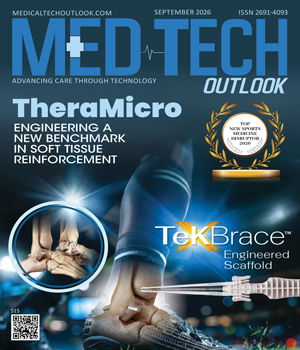
Our cover story features TheraMicro, recognized as the Top New Sports Medicine Disruptor 2026. Its TeKBrace™ platform takes a different approach to soft tissue reinforcement by studying the biomechanics of healthy ligaments and tendons and using those principles to guide the scaffold’s design. The company balances strength, elasticity, tissue integration and surgical workflow rather than optimizing one characteristic in isolation.
Also recognized is EstheticPro as the Top Aesthetic Microneedling Device 2026, combines practitioner-focused device design with science-based education.
BiLumix, recognized as the Surgical Headlamp Solutions of the Year 2026, integrates optics, lighting and power into wearable systems designed around clinician comfort. ARMS Medical, recognized as the Top Pelvic Floor Surgery Technology 2026, developed VNEW® by starting with female anatomy and designing its mesh-free dermal allograft around the needs of pelvic floor reconstruction.
The issue also features perspectives from leaders working at the intersection of technology and healthcare delivery. Cliff DeGraff, Assistant Director of Radiology at The University of Kansas Health System, examines how AI, automated protocols and advanced imaging tools can improve diagnostic workflows while keeping patient safety central. Hernando Garrido, Director of Manufacturing Engineering at Fresenius Medical Care North America, explores how business intelligence can give manufacturing and supply chain teams better visibility and support faster, more informed decisions.
Together, these stories show that meaningful progress in medtech comes from understanding the problem before designing the solution. We invite our readers to explore these perspectives and discover how better engineering, clinical insight and informed decision-making continue to shape the future of healthcare.