Medical Tech Outlook Weekly Brief
Be first to read the latest tech news, Industry Leader's Insights, and CIO interviews of medium and large enterprises exclusively from Medical Tech Outlook
What clinical problem in lumbar degeneration motivated development of the Restore device? In the initial stages of development, Dr. Sturm was asked, “So, what is this thing? What is it supposed to do?”, after completing his presentation of “Restore”, a completely novel and innovative spinal device, to a group of spinal instrumentation company executives. The engineer in the audience chimed in, “It’s the ‘Holy Grail of Spine’, If you can get it to work…” Well, Facet Dynamics, Inc. did just that, they “got it to work”… Lumbar degenerative disease remains one of the most prevalent and costly conditions in modern healthcare. It consistently ranks among the top expenditures in U.S. healthcare spending, reflecting both its frequency and the enduring realities of human biomechanics. As Dr. Chris D. Sturm, whose groundbreaking work in spinal surgery offers an innovative solution, “Restore”—the Emerging Lumbar Facet Joint Replacement Device—explains, lumbar degeneration is not a problem that will disappear. Human beings are upright organisms living under constant gravitational load. The motion segments of the spine—each composed of a disc and paired facet joints—are stacked in a configuration that allows movement to dissipate force. When that system deteriorates, pain and neurological compromise follow. For nearly eighty years, lumbar fusion has been the primary surgical solution for many degenerative conditions requiring stabilization. Fusion achieves stability by eliminating motion at the affected level. Yet the spine was designed to move. Each motion segment contributes to a cascade of load distribution. When motion is arrested at one level, force is transferred to adjacent segments, accelerating degeneration in those regions. This phenomenon, commonly referred to as adjacent segment disease, is a well-recognized clinical reality. Many patients who undergo fusion ultimately require additional surgery above or below the original construct. Public perception reflects this biomechanical tension. While fusion remains the standard of care in many situations, it carries a reputation for sacrificing natural motion. Artificial lumbar disc technology attempted to address this concern, but its primary contraindication—facet joint degeneration—limits eligibility for the overwhelming majority of surgical candidates. According to Dr. Sturm, facet degeneration is present in approximately ninety-eight percent of patients who would otherwise qualify for disc replacement. As a result, the posterior facet joint has emerged as a critical driver of the projected $18.2 billion lumbar spine market by 2030, with roughly eighty-five percent of that market influenced by facet-related pathology. Within this landscape, Facet Dynamics has developed an investigational unilateral lumbar facet joint replacement system designed to provide stability while preserving motion. The device is not yet approved for commercial use and remains in the regulatory and investigational phase. Its development has included bench testing, cadaveric evaluation, and structured consultation with the U.S. Food and Drug Administration. Regulatory clarity has been central to the company’s progression.
How does EvoSkin address structural aging at the subdermal level? EvoSkin, a boutique medical innovator in aesthetic technology, approaches non-surgical aesthetics through an inside-out treatment philosophy that targets structural tissue at the subdermal level, where laxity and age-related change originate. With ENDO-ONE, the company addresses a core limitation of many energy-based devices focused primarily on surface effects. The platform delivers consistent clinical outcomes while enabling scalable workflows across rooms, providers and locations. Guided by a physician-driven management and R&D team, EvoSkin works closely with medical aesthetic clinics and physicians globally, grounding product development and partnerships in clinical insight. ENDO-ONE reflects this clinical foundation through precision, biological respect and versatility. Clinically, it allows physicians to work precisely within connective tissue and adipose layers using an ultra-thin optical fiber. This enables effective tissue tightening and remodeling, with selective adipose interaction and minimal tissue trauma. For clinicians, this translates into natural-looking results and a high safety profile, a key factor in building long-term trust. Controlled, repeatable energy delivery ensures consistent, realistic outcomes across patients and anatomical areas. What role does dual-wavelength technology play in controlled tissue remodeling? Central to this performance is ENDO-ONE’s dual-wavelength diode fiber technology. By combining wavelengths with different tissue affinities, the system selectively targets connective tissue, water-rich structures and adipose layers within a single platform..


Why does dental sleep care require interdisciplinary precision and coordination? Dental sleep care sits at the intersection of dentistry and medicine, where airway health, joint stability, and long-term patient compliance must align for treatment to succeed. Every patient deserves precise care that goes beyond just fitting an appliance—it's about crafting a solution that enhances their quality of life and well-being. This is where Diamond Orthotic Lab plays a pivotal role. Each case relies on meticulous records, clear therapeutic intent, and personalized fabrication that reflect each patient's clinical reality. Early decisions shape outcomes, timelines, and patients' confidence in their treatment, well before an appliance reaches them. “We don’t just manufacture appliances. The real value is helping clinicians reduce variability and achieve predictable outcomes. At the end of every device is a patient, and that responsibility drives everything we do,” says Matt Rago, CEO and co-founder..
For millions around the world, hearing aid is a luxury. High-income countries have modest hearing aid adoption rate at around 35 percent, which plummets to just 5–10 percent in developing regions. Priced at $5,000-$6,000 per pair, prescription hearing aids are unaffordable for most, making access to treatment unequal. Yeasound is leading the charge in breaking this global inequality in access to advanced hearing solutions. A specialized provider of over-the-counter (OTC) hearing aids, it leverages cutting-edge audio technology and a self-developed AI-enabled application to improve hearing and transform lives. Its products combine the affordability and ease of access of OTC devices with the high quality of prescription ones. “Manufactured in-house, our OTC hearing aids deliver performance comparable to traditional prescription hearing aids at just one-third of the price,” says Joy Zhou, director of sales and marketing. Yeasound’s products are the next-generation evolution in hearing aid technology. Its technological proficiency is rooted in the 24-year audio engineering expertise of its parent company, Yealink, a premium provider of business headsets and video conference system hardware. The hearing aids are manufactured with top-tier proprietary chips and key components developed in-house that reduce the cost. Removing another barrier to access is its AI-powered iYeasound app. Its intelligent cloud system leverages a massive prescription database to deliver fast, accurate hearing profiles and three preset profiles covering over 80 percent of common hearing loss types. Through a custom-built workflow that combines a mobile app, personal computer and video consultations, the app integrates with remote fine-tuning services. It conveniently eliminates the need for multiple in-person fittings and adjustment sessions, further promoting access. A testament to Yeasound transforming lives by ensuring access is when it supported a user unable to afford her $4000+ prescription hearing aids due to expenses from her husband’s multiple surgeries. It offered her a cost-effective, warranty-backed, prescription-grade OTC solution. Her response, “You gave me back my life,” sums up the net impact.

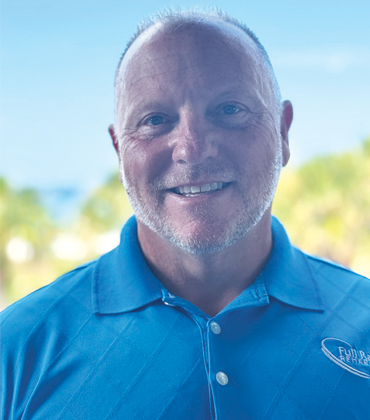
Jay Weiner, Owner and Executive Director
Most knee rehab devices are limited by design; they are single-leg systems that support either flexion or extension. But recovery requires more than isolated motion. Patients need synchronized, full-range movement to regain mobility and restore function. Yet no existing device offers treatment for both knees, across both motions, in a single unified system. That’s where Full Range Rehab’s EZ Stretch, an overpressure therapy device, stands apart. With a bilateral and bidirectional design, EZ Stretch delivers a full-range rehabilitation experience. It’s a one-of-a-kind device on the market that simultaneously treats both legs while supporting both key motions in a single system. This means clinicians can address two challenges at once, without needing separate equipment. “Our device was developed in close collaboration with orthopedic surgeons and physical therapists, shaped by hands-on clinical insight and built to meet the real needs of patients recovering from surgery or injury,” says Jay Weiner, owner and executive director. Nowhere are those needs more critical than in the early stages of rehab, when every degree of movement matters. At this phase, precision is essential—too little force stalls progress, too much risks re-injury. EZ Stretch addresses that balance with a patient-controlled electric actuator that automatically adjusts to each user’s stiffness and tolerance, delivering a personalized stretch that supports healing without compromising safety. Unlike conventional setups, the device gently distracts the joint during flexion and avoids compression during extension, maintaining anatomically correct movement throughout the recovery process. Combined with high-torque roller pads that deliver more force than any other device on the market, EZ Stretch helps patients break through scar tissue and regain functional range faster. To make the experience easy from day one, a trained service representative visits each patient’s home upon delivery to provide hands-on instruction. Once trained, patients operate the device independently using a simple handheld remote. One button initiates an extension stretch, while another activates flexion. The design eliminates the need for belts, straps or complex adjustments. A T-bar lowers over the thigh with one hand, making the device especially accessible for seniors or patients with arthritis and limited mobility.
Cardiovascular Devices

Thomas Draper, Vice President, Administrative Lead, Clinical Service Lines, Wellstar Center for Cardiovascular Care
Wound Care

Henri P. Gaboriau MD, FACS, Head Of Department ENT/Facial Plastic and Reconstructive Surgery, Adirondack Health
Orthopedic Devices and Instruments

Greg Jamison, MSN, RN, Director of Nursing, Mixed Acuity, Orthopedics, Neuro, Oncology, and Float Pool, UofL Health
Endoscopy
Joseph Ingrassia, Interventional Cardiologist, Director Vascular Medicine & Endovascular Intervention, Hartford Hospital
Drug Delivery Solutions
Jeffrey Dome, Senior Vice President, Children’s National Hospital
Drug Delivery Solutions

Laura Shue, Director of Analytics, Community Health System
In Vitro Diagnostics
Dr. Tyree Davis, chief medical officer for Ancillary Services, Nevada Health Centers

Medical Device Design and Development
Michael Brant-Zawadzki, MD, FACR, Vice President Clinical Research Administration, CATALiST (Center for Accelerating Technology and Life Sciences Translation), Hoag Hospital Health System
Drug Delivery Solutions
Denise Juliano, Group VP of Life Sciences, Premier Inc
Customization and precision are redefining aesthetic devices by enabling personalized, controlled treatments that improve safety, consistency, practitioner confidence and patient satisfaction.
Advanced facet joint replacement devices restore spinal motion, reduce chronic back pain, and improve long-term mobility and quality of life.
Advancing the Next Phase of Medical Technology
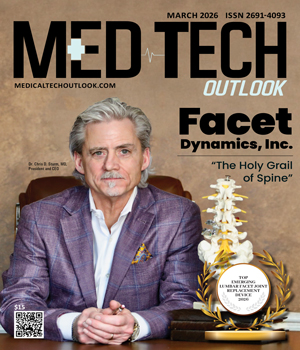
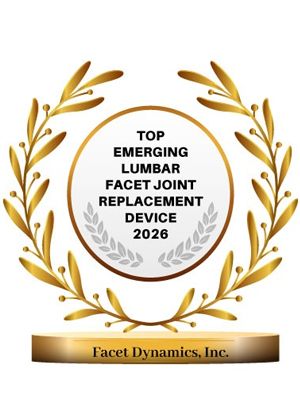
Our cover story features Facet Dynamics, named Top Emerging Lumbar Facet Joint Replacement Device 2026. Its investigational Restore system takes a biomechanical approach to lumbar degenerative disease, aiming to preserve spinal motion rather than eliminate it through fusion. Designed to replicate facet joint anatomy and integrate with existing pedicle screw systems, early cadaveric testing shows restored neutral-zone motion and reduced force at the screw–bone interface.
This issue also recognizes Diamond Orthotic Laboratory as Digital Dental Sleep Orthotics Solution of the Year 2026. The laboratory has built its reputation on precision workflows that integrate digital dentistry with clinical insight. By validating case records before fabrication and collaborating closely with clinicians, the company reduces variability and supports predictable outcomes for patients with sleep apnea, TMJ disorders and craniofacial pain.
EvoSkin, named as Most Trusted Medical Aesthetic Device 2026, focuses on minimally invasive aesthetic medicine through its ENDO ONE platform. Using dual-wavelength diode fiber technology, the device works at the subdermal level to tighten connective tissue and initiate collagen regeneration, delivering consistent results while supporting scalable clinical workflows.
This edition also brings forward leadership perspectives from Denise Juliano, Group VP of Premier Applied Sciences at Premier Inc., who discusses how real-world data, AI-driven analytics and collaborative partnerships are reshaping clinical research and accelerating evidence generation. Complementing this perspective, Greg Jamison, Director of Nursing at UofL Health, examines the operational realities of integrating international nurses into healthcare systems, highlighting both workforce challenges and the positive cultural impact these professionals bring to care teams.
Together, these stories illustrate a clear trajectory for medical technology: innovation grounded in clinical practicality, supported by data and guided by collaboration. We invite readers to explore this issue to better understand how today’s ideas are shaping tomorrow’s healthcare systems.