Medical Tech Outlook Weekly Brief
Be first to read the latest tech news, Industry Leader's Insights, and CIO interviews of medium and large enterprises exclusively from Medical Tech Outlook

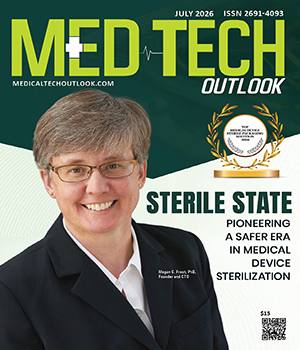
In the medical device industry, sterilization is a critical part of patient safety. For decades ethylene oxide (EO) sterilization was used. Ethylene oxide is a carcinogenic gas causing health concerns for workers, nearby communities and patients. Sterile State replaces the EO system with a new and safe sterilant; nitric oxide. This gas is created in the cells of all living things and is not a carcinogen. Nitric oxide has a one second half life. In medical device packaging, sterilization is gained at the same time a device is packaged. “We have created a safe, scalable method that protects patients, workers, and communities with only a change in packaging,” says Megan C. Frost, PhD, Founder and CTO. With the EO approach, medical devices are packaged and then shipped to a third-party sterilizer, where they are exposed to the carcinogenic gas in large chambers followed by venting the carcinogenic gas, which has caused documented exposure problems in the facilities and communities where this is done. Sterile State replaces this model with one in which no chamber is required, no carcinogenic gas is used, and the half-life of the gas Sterile State uses is one second. With the Sterile State system, packaging and sterilization take place in the same step. This system replaces the carcinogenic gas with the naturally occurring free-radical gas; nitric oxide. With the Sterile State System packaged medical devices no longer are trucked to and from sterilization chambers. Products are packaged and directly shipped to customers. The efficiencies associated with this system are extensive. It saves not just trucking expenses, but time, staffing and handling costs. “Our customers are the medical device manufacturers. With our system, they pay less for sterilization and save days to weeks getting product to market,” says Kurt D. Yockey, J.D., CEO. While the EO sterilization companies are suffering under a litigation load caused by using a carcinogenic gas, no such health risk is possible with the Sterile State System. Combining Chemistry and Materials Science for Real-World Application “Sterile State is an R&D-driven technology company. We create better materials; safe materials that speed products to customers while also delivering cost savings.” says Dr. Frost.
Radiation oncology environments are often saturated with imaging and clinical software systems, making workflow integration a major barrier to the adoption of new technologies. Kallisio designed its automated scan-to-print platform to require no additional IT integration, allowing personalized treatment delivery to fit within existing clinical workflows. Rather than centering itself around a single device, Kallisio positions Stentra, its first commercial product, as the initial application of a scan-to-print engine built for multiple patient-specific oncology applications. Stentra is an FDA 510(k) cleared, CE marked intraoral stent that positions and immobilizes the tongue and jaw during head and neck radiation therapy, displacing healthy tissue away from the treatment field to help minimize side effects and reduce treatment interruptions. Each device is 3D printed from an intraoral scan in less than 72 hours and reimbursed in the U.S. under an established CPT code. “We see a long-term opportunity in becoming the patient-specific device layer for precision oncology, and Stentra is the first proof point of that platform,” says Rajan Patel, CEO.

Biomechanics

Jisun J. Lee, MS, DPM, Mica Murdoch, DPM, Ashley McClain, DPM, Broadlawns Medical Center
MedTech

Nikki Ross, Senior Director, Sterile Processing, OhioHealth
Neuromodulation Devices

Hesham Abboud, Director, Multiple Sclerosis and Neuroimmunology Program, University Hospitals
Orthopedic Devices and instruments

Kimberly Plante Keefe, Respiratory Therapy Director, Franciscan Children’s
Dermatology Care

Courage Osagie, Director of Imaging Services, Scotland Health

Diabetes Care
Osama Hamdy, MD, Ph.D., FACE, Senior Endocrinologist, Joslin Diabetes Center, Associate Professor of Medicine, Harvard Medical School, Boston, MA

In Vitro Diagnostics
Steve Mantegani, Vice President of Operations, NovaCare Prosthetics & Orthotics
The sterile medical device packaging industry is evolving through innovation, sustainability, automation, and advanced materials to meet regulatory, safety, and efficiency demands.
Thermal ablation companies advance minimally invasive treatments through precision technologies, improving outcomes, reducing recovery times and expanding applications across healthcare.
Driving Progress Across the Continuum of Care
Our cover story features Sterile State, recognized as the Top Medical Device Sterile Packaging Solution 2026. The company is challenging long-established sterilization models through a nitric oxide-based packaging system that integrates sterilization directly into the package. By eliminating reliance on ethylene oxide and removing traditional sterilization bottlenecks, Sterile State is creating a safer, faster and more efficient pathway for medical device manufacturers while reducing complexity across the supply chain.
Also recognized in this edition is Nanotherm Therapeutics, the Thermal Ablation Company of the Year 2026. It is advancing a nanoparticle-based thermal ablation platform designed to give clinicians greater control in localized cancer treatment while preserving patient quality of life.
Kallisio, recognized as the Custom 3D-printed Immobilization Device of the Year 2026, is making personalized oncology more scalable through its automated scan-to-print platform, enabling rapid production of patient-specific devices that integrate into existing clinical workflows and support precision treatment delivery at scale.
This issue also features perspectives from industry leaders. Courage Osagie, Director of Imaging Services at Scotland Health, discusses expanding imaging access, strengthening workforce development and leveraging AI to improve operational efficiency and patient care. Nikki Ross, Senior Director of Sterile Processing at OhioHealth, examines how evolving regulatory expectations are reshaping packaging and sterilization strategies, emphasizing the importance of stakeholder collaboration, validation and early design considerations in medical device development.
The organizations and leaders featured in this edition demonstrate that meaningful progress often comes from rethinking established processes, strengthening clinical workflows and aligning technology with real-world healthcare needs. We invite you to explore these insights and discover how the next generation of medical innovation is being built across the industry.