Medical Tech Outlook Weekly Brief
Be first to read the latest tech news, Industry Leader's Insights, and CIO interviews of medium and large enterprises exclusively from Medical Tech Outlook
A featured contribution from Leadership Perspectives: a curated forum reserved for leaders nominated by our subscribers and vetted by our MedTech Outlook Advisory Board.

Dr. Joseph Ingrassia is a board-certified interventional cardiologist and Director of Vascular Medicine & Endovascular Intervention at Hartford HealthCare, where he is redefining cardiovascular care through innovation, precision and leadership. Trained at Columbia University Irving Medical Center and the University of Connecticut—where he served as Chief Medical Resident—he is an expert in coronary interventions, deep vein thrombosis and polyvascular disease. With an M.D. from Ross University and a Villanova science background, he blends evidence-based medicine with a profoundly human approach to treating complex cardiac conditions
Building Precision around People, Not Just Protocols
In medicine, precision is often measured in millimeters, heartbeats or lab results. For Dr. Ingrassia, however, it starts with how care is understood and delivered across a patient’s journey. Over time, he has seen that the most advanced interventions lose meaning without a system built around continuity, empathy and long-term thinking.
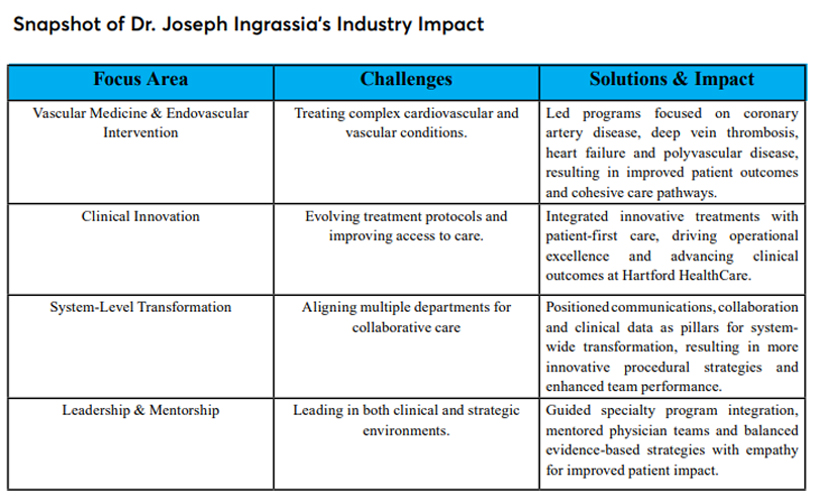 This perspective has shaped not just how he treats cardiovascular disease but also how he designs care itself. Lifesaving work begins before the procedure and continues well after discharge, bridging clinical disciplines, workflows and human connection. Every protocol he builds reflects this philosophy: precision must serve people, not just outcomes.
From Intervention to Integration
Dr. Ingrassia’s coronary and vascular intervention foundation, shaped during advanced fellowships at Columbia University Irving Medical Center and the University of Connecticut, gave him deep technical fluency. But it was his experience managing real-world cases—polyvascular disease, heart failure, deep vein thrombosis—that revealed a more urgent lesson: care needs to be interconnected.
“Ingrassia’s leadership has always been informed by close engagement with clinical teams. He focuses on designing systems that make high-quality care repeatable, whether analyzing procedural data, reviewing outcomes or identifying inefficiencies in multidisciplinary care”
Treating a single issue in isolation often ignores the systemic complexity behind it. This led him to reframe how programs should function. Rather than optimizing procedures in silos, he focused on building integrated pathways that address access, risk and recovery in one continuum. Success, in this model, isn’t just defined by a single intervention—it’s measured by how the system responds before and after.
Strategy Grounded in the Front Lines
Dr. Ingrassia’s leadership has always been informed by close engagement with clinical teams. He focuses on designing systems that make high-quality care repeatable, whether analyzing procedural data, reviewing outcomes or identifying inefficiencies in multidisciplinary care.
He has made communication and collaboration central to every program he oversees, treating them not as soft skills but as strategic tools. Operational clarity, shared benchmarks and consistent follow-through have become the building blocks of clinical cohesion. At Hartford HealthCare, his work directing vascular and endovascular medicine reflects this systems-first approach, improving alignment across departments while advancing the capabilities of frontline teams.
The Future is human and Intentional.
As cardiovascular care becomes more complex and technology more advanced, Dr. Ingrassia sees the future not as a race to adopt the latest tools, but as an opportunity to refine how care is delivered. His focus is intentional design, building scalable systems that balance speed with safety, innovation with continuity and specialization with simplicity.
Rather than separating technical excellence from human connection, his programs are built to unite both. Better outcomes emerge when care is structured, expectations are clear and teams are aligned—not just in expertise, but in purpose.
For Dr. Ingrassia, world-class care doesn’t depend on geography or resources alone. It comes from leadership grounded in presence, systems built for resilience and a collective belief that precision must serve something greater than itself—the patient’s long-term well-being.