Medical Tech Outlook Weekly Brief
Be first to read the latest tech news, Industry Leader's Insights, and CIO interviews of medium and large enterprises exclusively from Medical Tech Outlook
A featured contribution from Leadership Perspectives: a curated forum reserved for leaders nominated by our subscribers and vetted by our MedTech Outlook Advisory Board.


Although it did not receive high media attention yet, there is a huge concern with the end date of the transition period 26 May 2020 for going from the Medical Device Directive (MDD) to the Medical Device Regulation (MDR). The European medical device industry sent a letter on the 15thof April 2019 to the European Commission, that the Medical Device Regulation implementation is likely not ready on the 26th of May 2020. In addition, the USA sent a letter on the 24thof July 2019 to the World Trade Organization’s Committee on Technical Barriers to Trade, asking for a 3–year extension of the 26 May 2020 deadline.
"You do not need a crystal ball to predict that many medical devices will disappear after 26 May 2020"
After May 26, 2020 only those medical devices which are certified according to the requirements of the Medical Device Regulation (MDR) will be allowed in the market. Important pieces of the preparations for the MDR, like EUDAMED and Notifed Bodies designation are delayed, making in-time certification near to impossible. There is a limited grace period after May 26, 2020 for devices having an MDD certificate, but patient care is at risk in the near future and the medical device industry is shaking at its foundations. Why did this happen?
The ‘Old’ Medical Device Directive
The MDD works well and delivers safe medical devices. As a result, the (MDD) CE mark is accepted in many countries around the world. However, the MDD has four structural weaknesses:
1. The Notified Bodies, who check the medical device manufacturers are themselves checked by the Member State where they are located. The quality of those checks can differ significantly between the Member States as well as the quality of the Notified Bodies.
2. The MDD is based on strong safety (harmonized) standards about how to develop and make medical devices. In general, this works very well for existing products. However, for innovative products and certain implantables, there is not always enough clinical evidence to guarantee the maximum clinical safety.
3. The MDD does not have one central system for certificates and registrations, safety cases, and clinical studies. This makes it difficult to achieve coordination between the Member States and the European Commission.
4. Member States do not have enough legal possibilities to force manufacturers to improve if that is needed.
Two high-profile cases were touted to be the result of the MDD being too relaxed. However,these cases were mostly related to the four weaknesses mentioned above. The PIP breast implant case was false ,not even related to a weakness of the MDD. Inferior and cheaper industrial-grade (not medical grade) silicone was used for the outside of the implant and they were filled with silicone gell. The implants did rupture at a higher than normal rate. When compromised, the silicone gel was known to 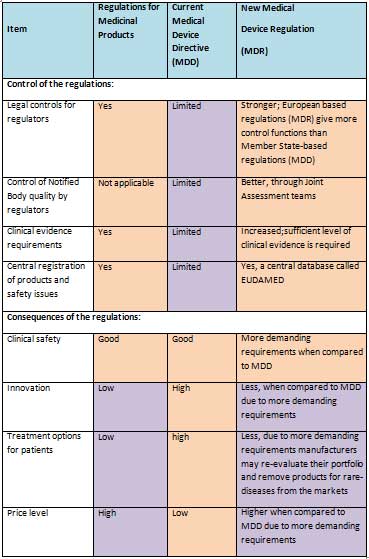 cause inflammation and possible scarring. This case was triggering the start of the MDR.
Implementation of the Medical Device Regulation
Regulators pushed for a strict and short transition period of three years for the MDR. However, the amount of work for such a large change has been underestimated. The regulators are working hard to do all the preparations, but it is unlikely that the preparations will be ready before 26 May 2020. First, when the preparations are finalized, the real transition can start to recertify all the medical devices.
Many Notified Bodies are not making the change to the MDR and this causes tremendous capacity shortages. Without a Notified Body there is no market access for a manufacturer. You do not need a crystal ball to predict that many medical devices will disappear after 26 May 2020. Brexit is only making a bad situation worse. In addition, the MDR implementation is complicating the trade of medical devices outside the EU.
Conclusion
The MDR is a huge step forward in solving the weaknesses of the MDD. However, it also increases the administrative threshold, time and costs to get medical devices to the market. The implementation time for the MDR is too short, which can causee problems for manufatures to re-certify their MDD certified products. Since MDD medical devices are considered safe, it would be disappointing for the EU healthcare environment if the short implementation time for the MDR would make these medical devices disappear in the near future.